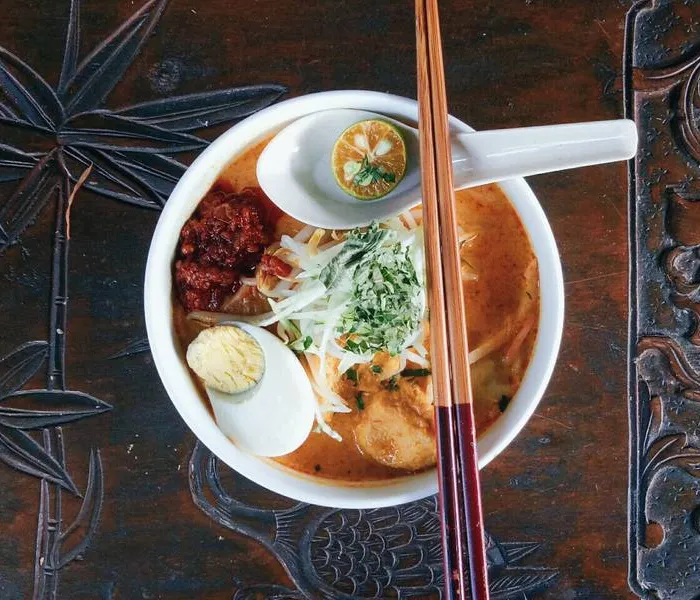
Laksa.
/lak-sa/
Spicy noodle soup in coconut broth or tamarind. The two main versions — curry laksa and assam laksa — taste nothing like each other, and both are called laksa.
Ordering “laksa” without specifying which type is how tourists end up confused. There are two distinct dishes that share the name, and they taste nothing like each other. Curry laksa is a coconut milk broth — rich, thick, yellow-orange — most commonly found in KL and along the west coast. Assam laksa is tamarind-sour and fish-based, thinner in consistency, and is the Penang version. If you order laksa in Penang, assam laksa is the default. Everywhere else in Malaysia, curry laksa is what you will receive unless you specify.
For a Danish frame of reference, curry laksa is closer to a French bouillabaisse than anything you might find in a Thai restaurant in Copenhagen. It is not sweet or thin — the coconut base is dense and the prawn and lemongrass flavours layer into it. Assam laksa, by contrast, is sharp and acidic in a way that has no direct European equivalent.
What it tastes like
Curry laksa has a rich coconut broth with heat from sambal and fresh chilli. The toppings — tofu puffs, fish cake, prawns, sometimes hard-boiled egg — absorb the broth slowly. The noodles are typically thick rice vermicelli, though yellow egg noodles appear in some versions. The flavour builds as you eat: the coconut sweetens initially, then the chilli and shrimp paste push through.
Assam laksa is the opposite register entirely. The broth is sour and slightly fishy, the tamarind cutting through in a way that cleans the palate rather than coating it. The mackerel flakes in it have a strong flavour. There is no coconut. The two dishes share a name and the general category of noodle soup; that is where the similarity ends.
Where you find it
Hawker centres and kopitiams. Laksa is a sit-down lunch dish — you will not find it at a roadside cart or from a standing vendor. The cook typically has a large pot on a high flame and ladles to order. In Penang, most laksa stalls serve assam laksa; going to Penang and ordering “laksa” and then being surprised by the tamarind broth is a documented experience among first-time visitors. Elsewhere in Malaysia, the default is curry laksa.
What to watch out for
Both versions almost always contain shrimp paste or dried shrimp. Belacan is foundational to how Malaysian laksa works — a version without it would taste flat. Vegetarian versions are uncommon and often still contain fish stock even when the visible fish has been removed.
Assam laksa is built around mackerel (ikan kembung). It cannot be made without fish — the fish is the broth, not an addition to it. If you cannot eat fish, assam laksa is not the dish for you.
The heat level is high by Northern European standards. You can ask for it milder (kurang pedas) but the flavour profile shifts when the sambal is reduced. A mild curry laksa is a different dish from the version locals eat.
Prices are approximate, based on 1 MYR ≈ 1.65 DKK.
Ingredients not always on the menu.
Listed here so you can decide before you order.
- 01 shrimp paste(belacan) in most versions
- 02 dried shrimp
- 03 fish cake
- 04 fish stock(in assam laksa)