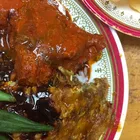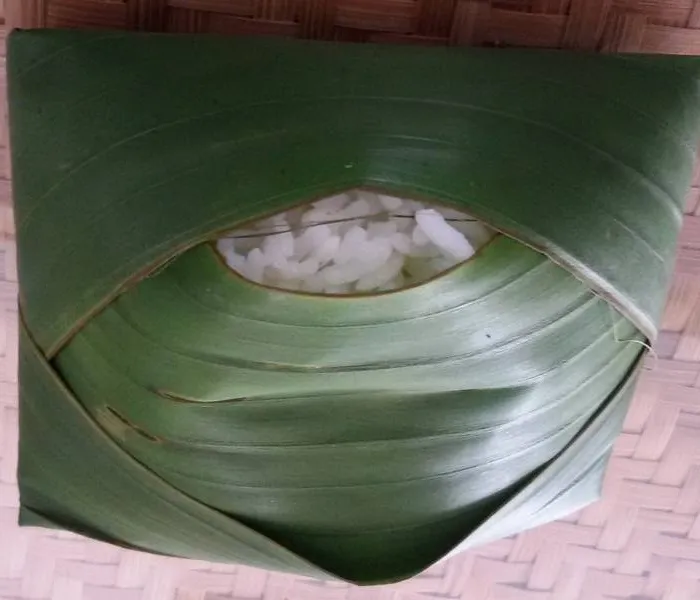
Banana LeafRice.
/ba-na-na leaf rice/
White rice and multiple small curries served on a banana leaf. You eat with your right hand. The refills are included and offered without asking.
A banana leaf is placed in front of you, a server scoops rice onto it, and then small portions of curry, dhal, rasam, and vegetables arrive around the rice. You did not order any of this individually — the format is the order. Sitting down at a banana leaf restaurant initiates the sequence without prompting.
The closest concept a Dane would recognise is a smørrebrød lunch spread, but instead of open sandwiches you have rice surrounded by four to six different dishes, each one a different flavour register, and you mix them as you eat. The rasam is poured over the rice to moisten it. The dhal sits alongside. The main curries are there to be mixed in or eaten from the leaf separately, depending on preference.
What it tastes like
The rasam — a thin, peppery, slightly sour soup — is usually poured over the rice first. It is watery but sharp, and it loosens the rice in a way that changes how the other components interact with it. The dhal is mild and earthy. The main curries (fish curry and chicken curry are standard; there will be at least one vegetable curry) carry the heat and the depth. The papadum adds crunch. Eating everything separately gives you a collection of good dishes; eating them mixed is what the meal is designed for.
How to order
Sit down at a banana leaf restaurant and the system starts without you asking. Rice is placed on the leaf, curries follow. You can point at the dishes along the counter or at the servers carrying pots and ask for more of anything — refills are included in the price and offered without charge.
When you are finished, fold the leaf toward you (in the direction of your body). Folding it away from you is a signal that the food was not to your liking — it is a cultural communication, not just tidying up. Eat with your right hand if you are comfortable; a spoon is available without comment if you prefer it.
The price is fixed for the format — rice, dhal, rasam, vegetables, one piece of fish or chicken curry, and papadum. Additional proteins or premium items may add to the total. Twelve ringgit will cover a standard banana leaf rice at most Indian restaurants.
What to watch out for
The rasam is almost always fish-stock based. It is not vegetarian despite having no visible fish — the broth is built from dried fish or anchovies. A purely vegetarian order requires confirming this.
Ghee is used on the banana leaf before the rice is placed, and appears in many of the curries. It is not vegan. Vegetarian versions exist but ghee is often still present — confirming at the point of ordering is the only reliable way to know.
The heat level is genuine. The fish curry and main curries are spiced for a South Indian palate, which is several steps above what most Northern European visitors expect from Indian food. The dhal and rasam are the milder elements; if you need to manage spice, stay closer to those.
Prices are approximate, based on 1 MYR ≈ 1.65 DKK.
Ingredients not always on the menu.
Listed here so you can decide before you order.
- 01 ghee(brushed on the banana leaf, used in many of the curries)
- 02 fish-based rasam(the thin pepper soup served alongside — almost always fish stock)
- 03 anchovies in some curries