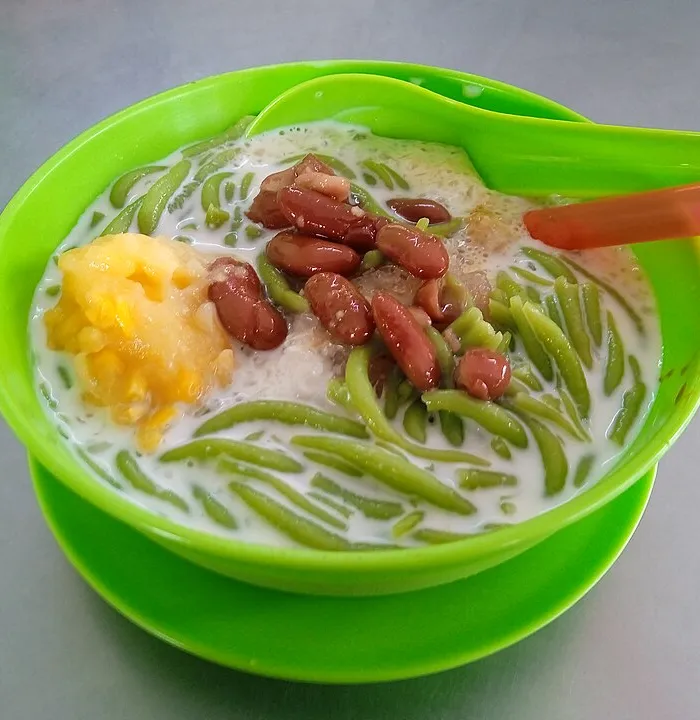
Cendol.
/chen-dol/
Shaved ice with coconut milk, green rice-flour noodles, and palm sugar syrup. A Nyonya dessert with a specific, slightly vegetal sweetness from the pandan in the noodles.
Cendol is a bowl of shaved ice with three things: green rice-flour noodles (the cendol itself), coconut milk poured over the ice, and dark palm sugar syrup. The noodles are made green with pandan leaf extract and have a slightly vegetal sweetness that does not resemble anything in Danish dessert cooking. Pandan is its own flavour — grassy, slightly floral, and warm — and it is the defining note of the dish.
The closest structural comparison in Denmark is koldskål, the cold dairy dessert eaten in summer. Both are cold, both are served in a bowl, and both work because of the contrast between temperature and flavour. But cendol is lighter, the flavours are tropical where koldskål is vanilla and lemon, and the textures are entirely different. Cendol is a hot-weather dessert and it functions precisely because of the contrast between melting ice and thick coconut milk.
What it tastes like
The coconut milk is rich and slightly salty — not sweet on its own. The palm sugar (gula melaka) is darker and more molasses-like than white sugar and gives the syrup a depth that plain sugar would not produce. The green noodles are slippery, mildly sweet, and carry the pandan flavour. The whole thing dilutes as you eat it: the ice melts into the coconut milk, and the flavours soften. Eat it quickly; cendol is not a dessert to contemplate over twenty minutes.
The Nyonya heritage
Cendol is Nyonya in origin — from the Peranakan Chinese-Malay community of Penang and Malacca, who developed a cuisine over centuries by fusing Chinese techniques and ingredients with Malay ones. The pandan leaf, the coconut milk, and the palm sugar are all Malay ingredients applied to a Chinese dessert framework. The result is something that does not map cleanly onto either parent cuisine, which is the characteristic of Nyonya cooking. Understanding this context is the difference between eating it as a snack and understanding what it is.
Where you find it
Hawker centres and dedicated dessert stalls. It is a daytime dessert — the natural moment is after a heavy lunch of laksa or nasi kandar, when something cold and light makes sense. There is no need to seek out a famous stall; any hawker centre version made with proper gula melaka is the correct version.
What to watch out for
Palm sugar is not white sugar. The flavour is unfamiliar on first encounter and some people find it stronger than expected. Cendol is entirely vegan and dairy-free — the coconut milk is the only fat source and it is plant-based.
Prices are approximate, based on 1 MYR ≈ 1.65 DKK.
Ingredients not always on the menu.
Listed here so you can decide before you order.
- 01 palm sugar(gula melaka) — not always disclosed on menus, distinct from white sugar
- 02 pandan leaf extract(colours and flavours the green noodles)